

Why Spartan Forge Belongs in Every Morel Hunter’s Back Pocket

This post was posted with permission from Shon Butler over at Longspur Tracking
Most people think of a hunting app as a deer tool. Waypoints for stands, wind direction for the rut, boundary lines so you don’t end up on the wrong side of the fence. Fair enough — that’s how most of these apps are marketed. But if you’re walking the spring woods of West Virginia with a mesh bag and a sharp eye, you already know morel hunting is every bit as technical as chasing a mature buck. You’re reading the same land, the same soils, the same micro-terrain. You’re just looking for a different kind of quarry.
That’s why Spartan Forge has quietly become one of the most useful tools I carry into the mushroom woods.
Morels Are a Terrain Game
Find a morel hunter who’s been at it for twenty seasons and you’ll find a person who talks about dirt, slope, and trees the way a forester does. Morels don’t grow randomly. They key on specific indicator species — dying slippery elm, emerald ash borer-killed white ash, tulip poplar, sycamore along the bottoms, and old apple orchards that somebody’s great-grandfather planted and the woods reclaimed fifty years ago. They key on soil temperatures in that 50-to-60-degree window. They key on south-facing slopes early in the season when the ground warms first, then migrate up the hill and into the hollows as April rolls into May.
Every one of those variables is something you can read off a good map if the map is good enough. Spartan Forge is good enough.
LiDAR: The Feature That Changes Everything
The single most valuable tool in Spartan Forge for a morel hunter is the LiDAR layer. LiDAR (Light Detection and Ranging) strips the canopy off the landscape and shows you the bare earth — every drainage, every bench, every old skid road, every homestead foundation hidden under sixty years of regrowth.
This matters because morels love edges and subtle terrain features that are completely invisible on satellite imagery. That old farm road cut into the hillside in 1947? Morels grow along the uphill lip where the disturbed soil has settled. That flat bench halfway up a ridge? Classic poplar morel ground. The foundation of a long-gone farmhouse with the remnant apple trees still alive around it? I don’t need to tell you what grows there in late April.
Spartan Forge’s LiDAR coverage is a meter-resolution across most of the lower 48, and in the steep country of Appalachia, that detail is the difference between wandering and hunting.
UAV and Historical Imagery: Read the Trees Before You Walk
Spartan Forge’s high-resolution UAV imagery lets you zoom in tight enough to identify individual trees from your truck. For a morel hunter, that’s huge. I can scout a 300-acre tract from my kitchen table and flag every suspected dying ash, every tulip poplar stand on a south-facing draw, every sycamore bottom, every old orchard footprint — before I ever lace up my boots.
The leaf-off historical imagery is just as valuable. In the bare-tree shots you can see the structure of the canopy, the gaps where ash has died and fallen, the distinct crown shape of poplar versus oak. Combine that with current leaf-on imagery and you’re building a tree-level map of your hunting ground. That’s not e-scouting for deer. That’s e-scouting for fungi.
Slope, Aspect, and Sun Exposure: Timing the Season
Morels move through the season on a temperature gradient. Early flush is almost always on warm south and southwest-facing slopes where the soil hits that magic window first. As the season progresses, you chase the temperature up the elevations and into the cooler north-facing hollows and creek bottoms, where the morels emerge a week or two later.
Spartan Forge’s slope angle layer and sun exposure layer let you plan exactly that progression. In early April in West Virginia, I’m filtering my map to highlight south-facing slopes between certain elevations. By the last week of April, I’m looking at the opposite aspect and the higher country. You’re essentially building a temperature map of your ground, and the morels will tell you whether you read it right.
Weather Data That Actually Helps
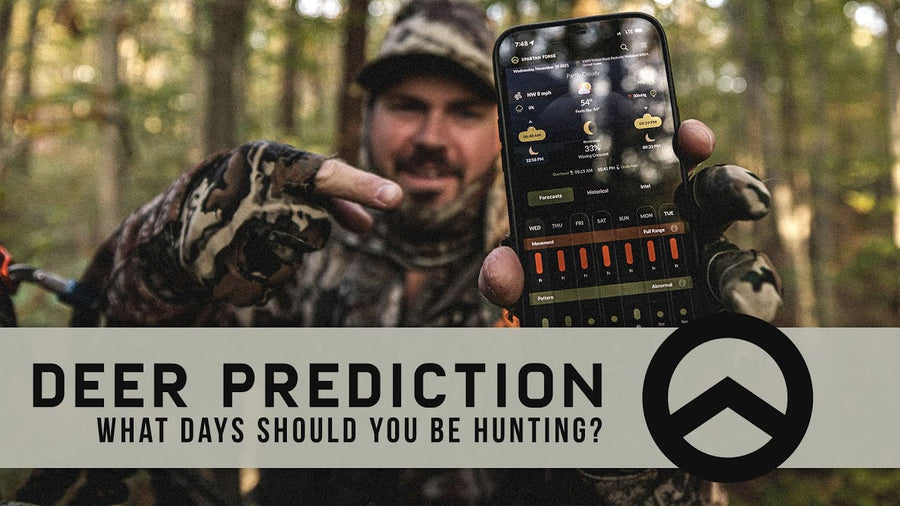
Morels need moisture and heat. You need a couple of good warm days after a steady rain, with night temps staying above 50. Spartan Forge carries hourly weather forecasts and historical weather data at your exact pins. That historical piece is the sleeper feature — being able to look back at what the weather did the week before you hit a honey hole last year tells you exactly when to start checking this year.
Waypoints That Pay You Back Year After Year
Here’s where a mushroom hunter really earns his keep: a productive morel spot produces for years, sometimes decades, if you don’t over-pick and you let the caps mature enough to sporulate. Every serious morel hunter I know keeps a mental map of his spots. Spartan Forge lets you drop a pin with notes — what tree, what aspect, what date, how many pounds. Three seasons later, you can open the app and walk right to a spot you haven’t visited since 2023 and know exactly what conditions produced it.
That’s institutional knowledge you can pass to your kids. And if you’ve ever hunted morels in West Virginia, you know that’s the whole point.
Public-Private Boundaries Matter Here Too
Morel hunting on public land is legal in West Virginia within the usual rules, but the second you cross a fence onto private without permission you’re trespassing — same as if you were packing a shotgun. Spartan Forge’s parcel data is reliable enough that I use it to sort out boundaries before I ever park the truck. The ownership notifications also tell you when a tract has changed hands, which in today’s land-buying climate is information every public-land user needs.
The Woodsman Plus the Tech
I’ll never tell anybody that an app replaces time in the woods. You can’t app your way to reading a fresh turkey scratch or recognizing the smell of a ramp patch or knowing which side of the tree to check first. Thirty years of walking the hills teaches you things no software will ever match.
But when you layer a serious tool like Spartan Forge on top of that woodsmanship, you stop burning daylight on dead ground. You walk into the woods with a plan built on terrain, trees, temperature, and history — and you walk out with a heavier bag.
That’s the Longspur way. Work smarter, track better, and respect the resource enough to do your homework.
Check out Longspur's Youtube video on the subject for more information!